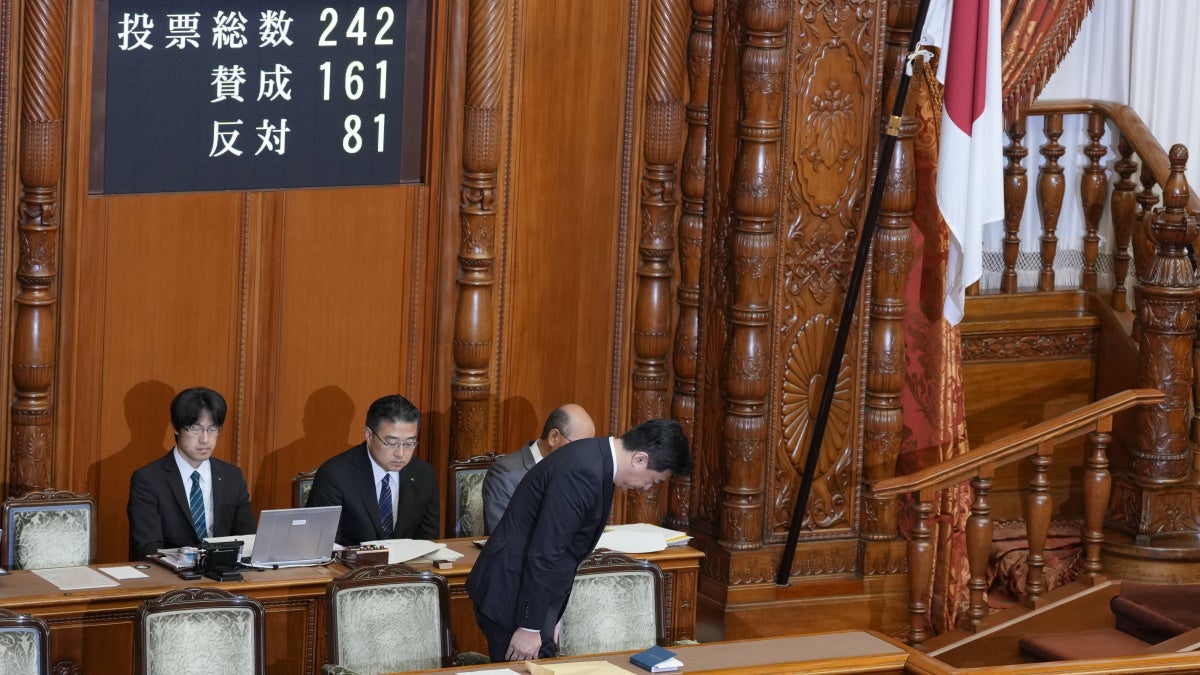
Japan's chief cabinet secretary, Minoru Kihara, bows to members of the House of Councilors after lawmakers passed a law prohibiting desecration of the national flag, Tokyo, July 17, 2026.
(Tokyo) – The Japanese Diet on July 17, 2026, adopted a flag desecration law that criminalizes damaging Japan’s national flag, a violation of the right to freedom of expression, Human Rights Watch said today. Japan’s ruling Liberal Democratic Party, its coalition partner Japan Innovation Party, and three opposition parties supported the bill during a session of the Diet’s upper house, following passage by the lower house on June 30.
The law prohibits “publicly damaging, removing, or defacing” Japan’s national flag in a “way or situation that evokes significant discomfort or disgust in people.” People charged with this offense face penalties of up to two years in prison or a maximum fine of 200,000 yen (about US$1,250), identical to article 92 of Japan’s Penal Code, which criminalizes the desecration of foreign flags.
“Japan’s flag desecration law poses a direct threat to the right to freedom of expression,” said Teppei Kasai, senior Asia program officer at Human Rights Watch. “By chipping away at this fundamental right, the law sends a message that puts everyone’s basic liberties at risk.”
The flag desecration law undermines the right to freedom of speech and expression in violation of international human rights law. Japan is party to the International Covenant on Civil and Political Rights (ICCPR), which in article 19 protects the right to freedom of expression, including symbolic acts. Legal restrictions to protect public order or national security are permitted only if they are necessary and proportionate.
The United Nations Human Rights Committee has been clear that causing offense to patriotic sentiment or speech regarded as “deeply offensive” does not justify crim


