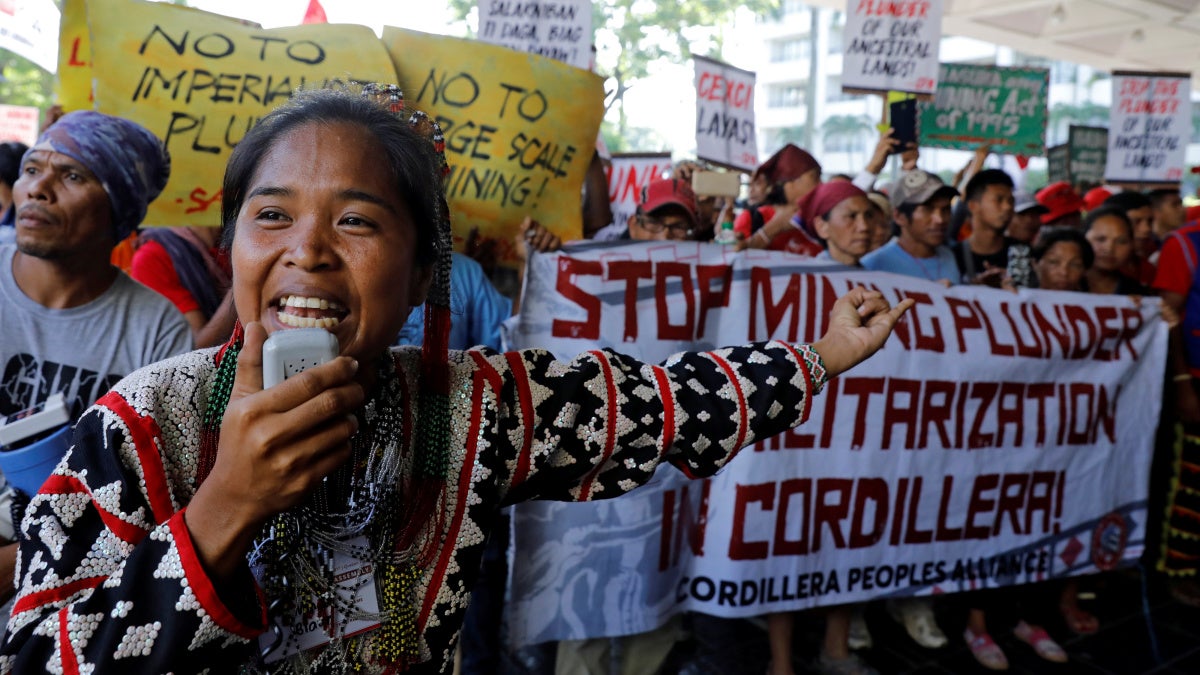
An anti-mining protester speaks during a rally outside the annual Philippines mining conference in Pasay, Metro Manila, September 6, 2017.
(Manila) – The Philippine government’s revised national guidelines on free, prior, and informed consent (FPIC) threaten the rights of Indigenous communities, Human Rights Watch said today. Philippine authorities should align these guidelines with international human rights standards.
On May 1, 2026, the Philippine National Commission on Indigenous Peoples (NCIP), which issues rules and regulations related to the 1997 Indigenous Peoples Rights Act, announced that it had approved revised guidelines for projects affecting Indigenous communities. The guidelines were first issued in 2012 to ensure that Indigenous peoples could make decisions in accordance with their customary traditions about laws, policies, and projects that affect them.
“The National Commission on Indigenous Peoples’ revised guidelines would severely undermine the ability of Indigenous communities to provide free, prior, and informed consent for company projects in the Philippines,” said Lian Buan, Southeast Asia researcher at Human Rights Watch. “The Philippine government has a duty to ensure that private corporations cannot bulldoze through the rights of Indigenous people.”
After the commission’s May 1 announcement, Indigenous groups and members of Congress urged the Commission to make publicly available its proposed revisions to the guidelines. Human Rights Watch has a copy on file.
The 2026 revised guidelines focus on the requirements of Indigenous communities to consider whether they will provide free, prior, and informed consent for private businesses activities. They impose shortened periods for Indigenous communities to build consensus for decisions, contrary to the Indigenous Peoples Rights Act, which puts primacy on customary traditions for rea


