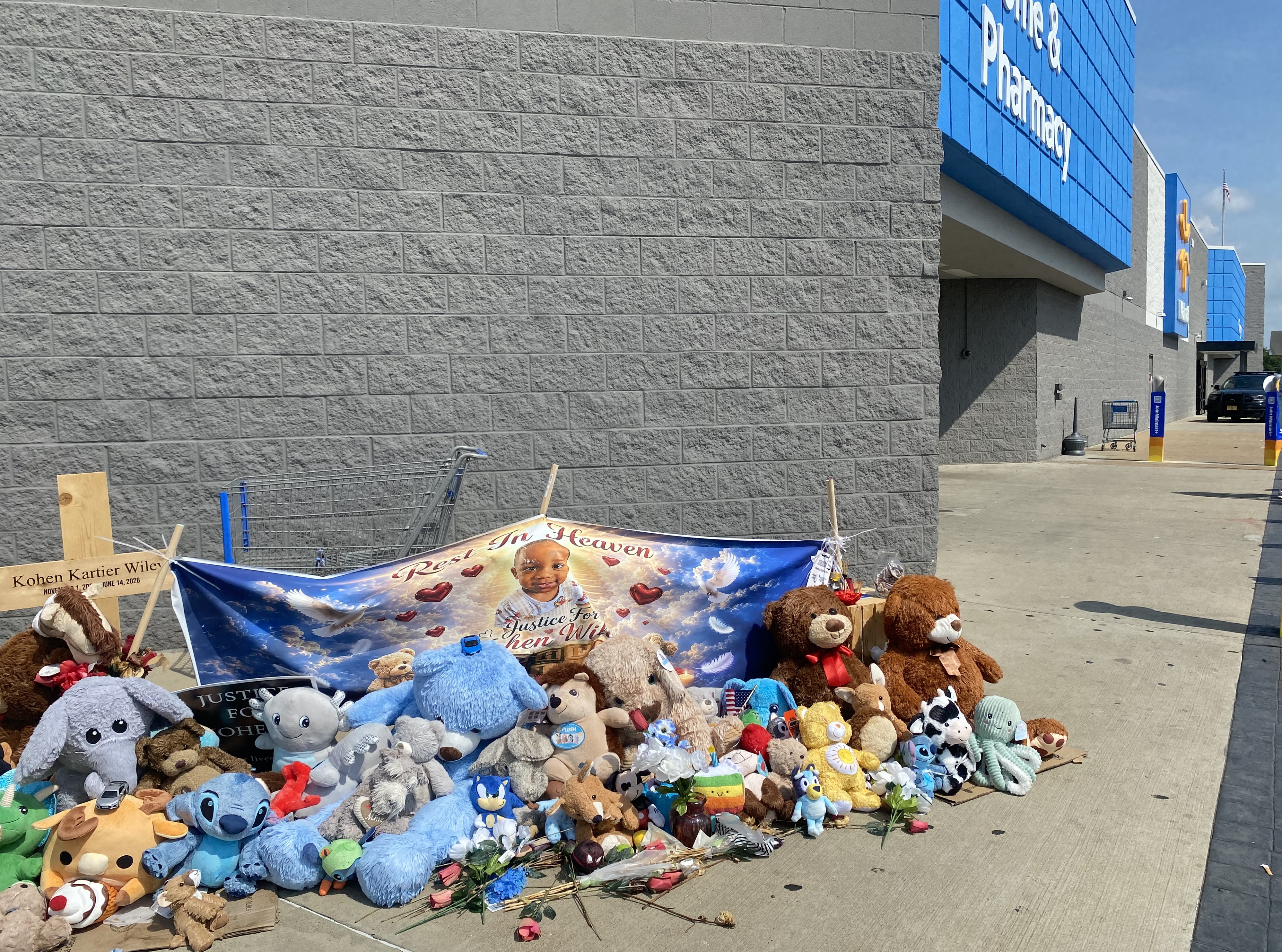
Outside the Walmart
in Senatobia, Mississippi, where police shot and killed 1-year-old Kohen Wiley, a shrine of stuffed animals sits between the garden center and the pharmacy. There are teddy bears, elephants, and kangaroos with babies in their pouches. There is a Bluey plush toy — Kohen’s favorite cartoon — along with matchbox cars, a green plastic tractor, and an array of artificial flowers.
A banner frames the display, featuring a celestial image of baby Kohen wearing gingham overalls. A handwritten sign reads, “Justice Delayed is Justice Denied.”
In the parking lot, a cop pulled a gun on a gray Ford Fusion on a Sunday afternoon and fired while Kohen’s mother held him in the passenger’s seat. A bullet struck the child on his right side, tearing through his small body and exiting his left. The driver, who was also hit, sped to a hospital, but it was too late. At 19 months old, Kohen was dead.
The killing sparked anguish and rage in Senatobia, a small city some 40 miles south of Memphis, Tennessee. At protests and press conferences, people demanded answers, while officials stayed mostly silent. It took several days for the mayor to deliver a scripted
video statement
that did not even include the child’s name.
The Mississippi Bureau of Investigation announced a probe into the case. Speaking before an agitated crowd, state Department of Public Safety Commissioner Sean Tindell
said
this could take months, refusing to say when — or even whether — his agency would provide further updates.
Until then, the official narrative would be a version of a familiar tale told by those who kill under color of law: On June 14, Senatobia police
got a shoplifting call
from Walmart over baby clothes and a pack of Pampers diapers. According to an MBI
press release
, officers tried to stop “two subjects and a juvenile child fleeing from the store.” The suspects “drove in the direction of the officers, almost striking one.” That’s when an officer fired.
Police offered
… [more]

