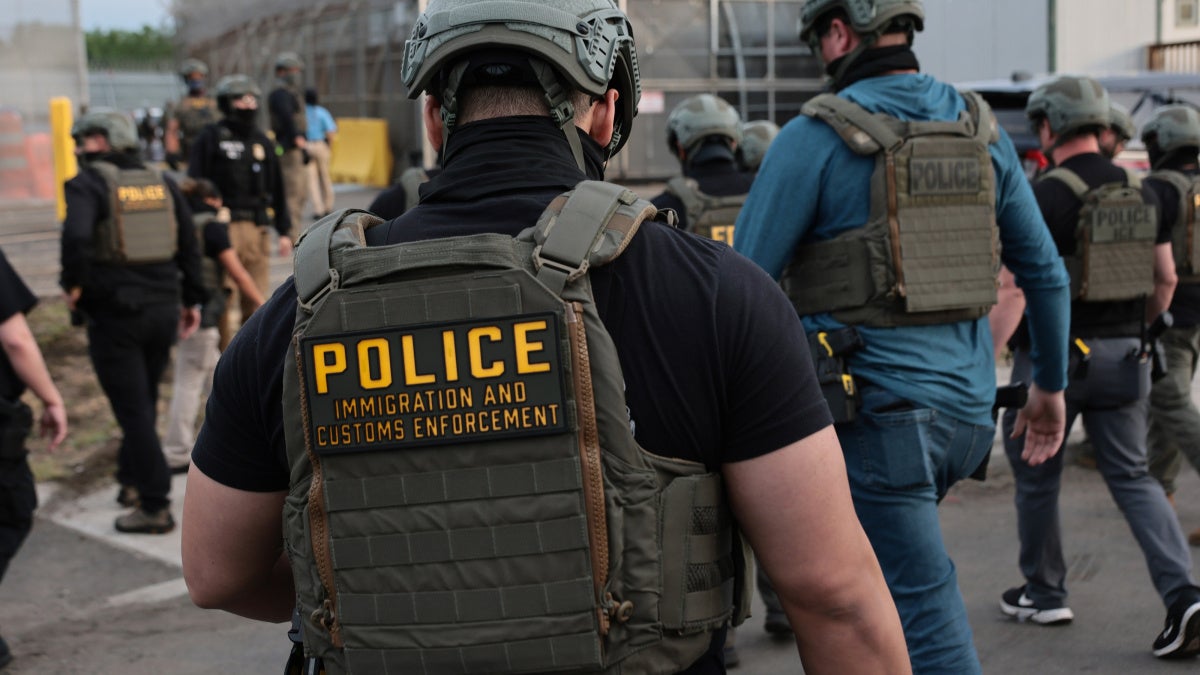
US Immigration and Customs Enforcement (ICE) agents block protesters as cars exit Delaney Hall, which is being used as an ICE detention center, on May 27, 2026 in Newark, New Jersey.
Representatives Delia Ramirez and Hank Johnnson, both members of US Congress, held a shadow hearing on US Immigration and Customs Enforcement’s (ICE) use of technology on July 15.
Witnesses at the hearing detailed how the Department of Homeland Security (DHS) is building an increasingly vast network of interconnected data collection and processing systems. ICE reportedly relies on surveillance platforms, facial recognition tools, iris scanners, and spyware—all developed by private companies—to identify and track individuals and cross-reference with sensitive data held in federal, state, and commercial databases.
Witnesses expressed concern that this data would then be used to profile and intimidate people in ways that chill protest, limit access to essential services, and undermine rights to privacy, nondiscrimination, due process, and free expression.
Human Rights Watch documented surveillance of observers and protesters by ICE agents during immigration operations in Minnesota in December 2025 and January 2026. This research included cases of agents driving to observers’ own homes, raising serious concerns about intimidation and how ICE agents seemingly have access to observers’ addresses and other personal data. Journalists reported ICE agents appearing to scan Minnesota residents’ faces with Mobile Fortify, a DHS application that reportedly compares face and fingerprint scans against data held on government databases.
ICE’s use of surveillance technology and their expanded access to personal data could increase the agency’s ability to identify and monitor specific individuals, risking further instances of wrongful targeting, racial profiling, and family separation across