Before President Donald
Trump threw his latest hand grenade into congressional negotiations over a key domestic spying law, two factions of Senate Democrats seemed to believe they were on the verge of a breakthrough.
Privacy advocates thought they had their best chance in years of passing reforms, including a warrant requirement for searching American communications collected abroad.
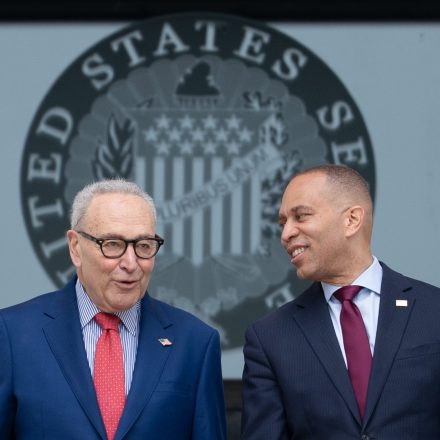
Are Jeffries and Schumer Getting Ready to Greenlight Domestic Spy Power for Trump?
Centrists allied with U.S. intelligence agencies, meanwhile, thought they were close to renewing Section 702 of the Foreign Intelligence Surveillance Act with only minor tweaks.
Then Trump, who had once already thrown the renewal process into chaos, announced on Wednesday that he wouldn’t sign it unless Congress passed an unrelated voter suppression bill.
Claiming that Democrats were poised to walk away from a spy law compromise, Trump said that “to add a slight bit of intrigue but, for the Good of the Nation, and the People of our Country, I will not approve FISA without THE SAVE AMERICA ACT going along with it.”
Trump’s surprise outburst on Truth Social on Wednesday scrapped the confirmation hearing set later in the day for Jay Clayton, a federal prosecutor in New York, to serve as the permanent director of national intelligence. Senate Majority Leader John Thune, R-S.D., had said that he hoped to quickly confirm Clayton.
Clayton’s impending confirmation had
appeared to solve a problem
— at least for some Democrats — that Trump created by tapping lapdog housing chief, Bill Pulte, as the Cabinet-level intelligence chief. It might also have opened a route for Congress to renew Section 702, the surveillance law that allows federal agents to conduct “backdoor,” warrantless searches of Americans’ communications collected abroad.
In a joint press conference on Wednesday, top Senate Democrats revealed the cracks in their coalition over next steps on FISA.
A key reformer
… [more]