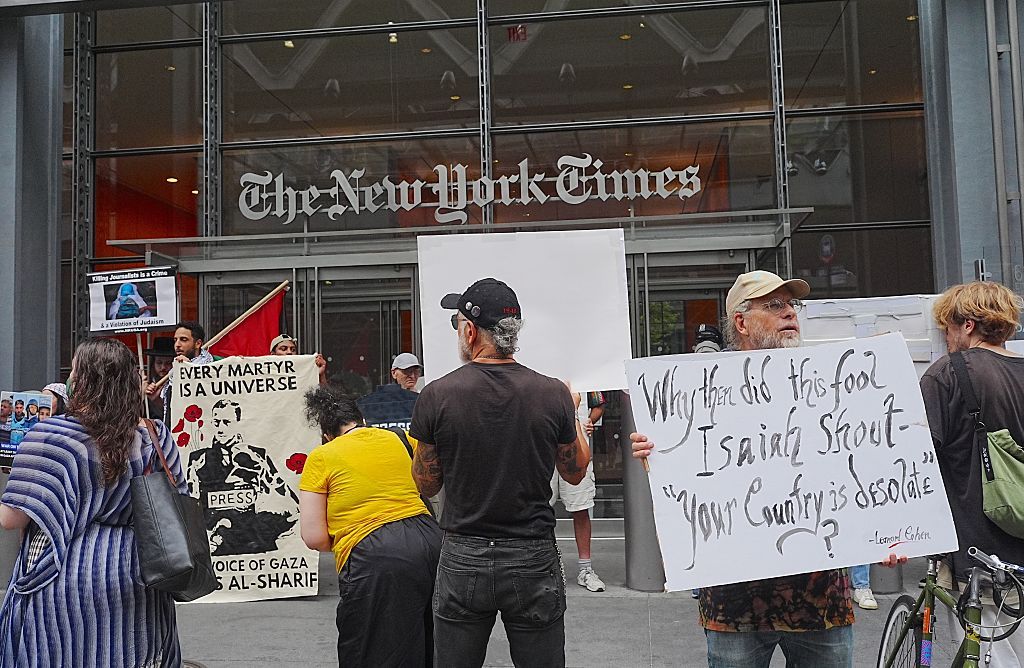
Protesters picket the New York Times to demand justice for Palestinian journalist Anas Al-Sharif and other journalists killed in Gaza by Israel, on Aug. 10, 2026, in New York City.
Photo: Selcuk Acar/Anadolu via Getty Images
The New York Times
recently published a sweeping accounting of President Donald Trump’s campaign against the American press: FBI agents arriving at reporters’ homes, subpoenas for journalists’ records, Pentagon access restrictions, regulatory pressure on television networks, numerous lawsuits against news organizations, and an increasingly
politicized
Federal Communications Commission.
“Almost 20 months into Mr. Trump’s second term, his long-running media clashes have grown into a sweeping campaign to control speech in America that stands out for applying so many levers, so fast, all at once,” Times reporters Maggie Haberman and Jim Rutenberg
wrote
. “Each time the president assails what has long been considered protected speech … he is eroding norms and undercutting the role of an independent press.”
All told, it is a damning inventory.
It is also difficult to read without noticing who occupies almost every frame:
Us.
Reporters. Editors. Television hosts. Networks. Publishers. Their lawyers. And
the access
our industry has become so reliant upon.
Amy Goodman on the Media’s “Access of Evil”
The Times is right about the threat. Trump has indeed weaponized
government agencies
and
private litigation
against
news organizations
in ways that seriously threaten the First Amendment, although judges have repeatedly rebuked parts of the administration’s legal strategy. But Trump’s
attacks on free speech
have extended well beyond the journalism, from
ICE protesters
in Los Angeles to faculty in solidarity with Palestine on
college campuses.
But somewhere along the way, the American press began conflating two things: press freedom, with the conditions under which the press had become accustomed.
Tho
… [more]