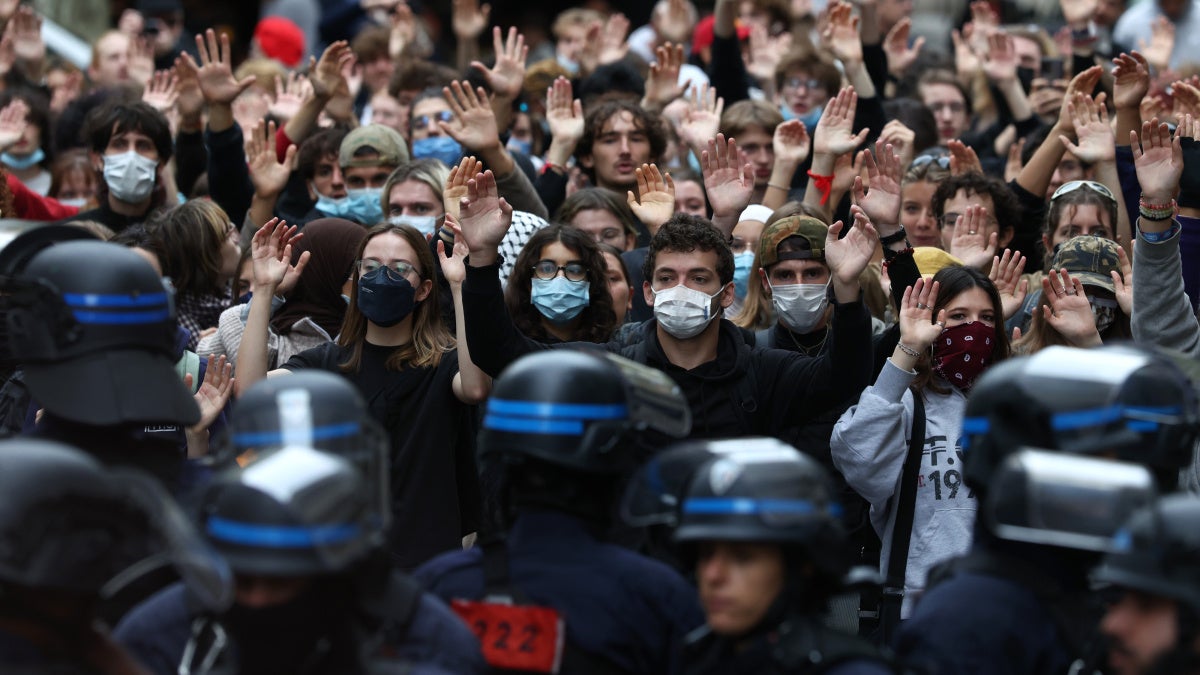
Students raise their hands in front of police officers as they demonstrate outside Sciences Po during a protest over school overcrowding and decay in Paris, France, October 7, 2026.
Images from ongoing student protests in France of heavily armed riot police using tear gas, stun grenades, batons, rubber bullets, and rough restraint techniques on children have sparked national and international concern.
High schoolers across France have taken to the streets since September 21 frustrated with the government’s continued under-investment in their education, which has resulted in a shortage of teachers, too large classes, and inadequate school buildings. While schools have been blockaded and some protesters have engaged in violence, the protests have been overwhelmingly peaceful.
Police use of force in response to the protests has resulted in serious injuries to children, including a 15-year-old boy who lost a hand to an explosive police stun grenade and a 14-year-old boy whose jaw shattered from a police tear-gas canister fired at close range. The government announced a temporary suspension of the use of stun grenades.
Police have reportedly detained more than 6,800 people since the demonstrations started; with apparently 86 percent of them, children. Authorities have also reportedly opened 36 internal investigations into allegations of police misconduct. But internal reviews in France rarely translate into real accountability.
Police use of excessive force during protests is not new in France. Human Rights Watch documented severe injuries caused by police during the 2018 “Yellow Vest” movement. And 2023’s pension reform protests and environmental demonstrations were also marked by such use of force. The current student protests began in schools in working-class neighborhoods, where racialized young people constantly experience and fear police harassment and