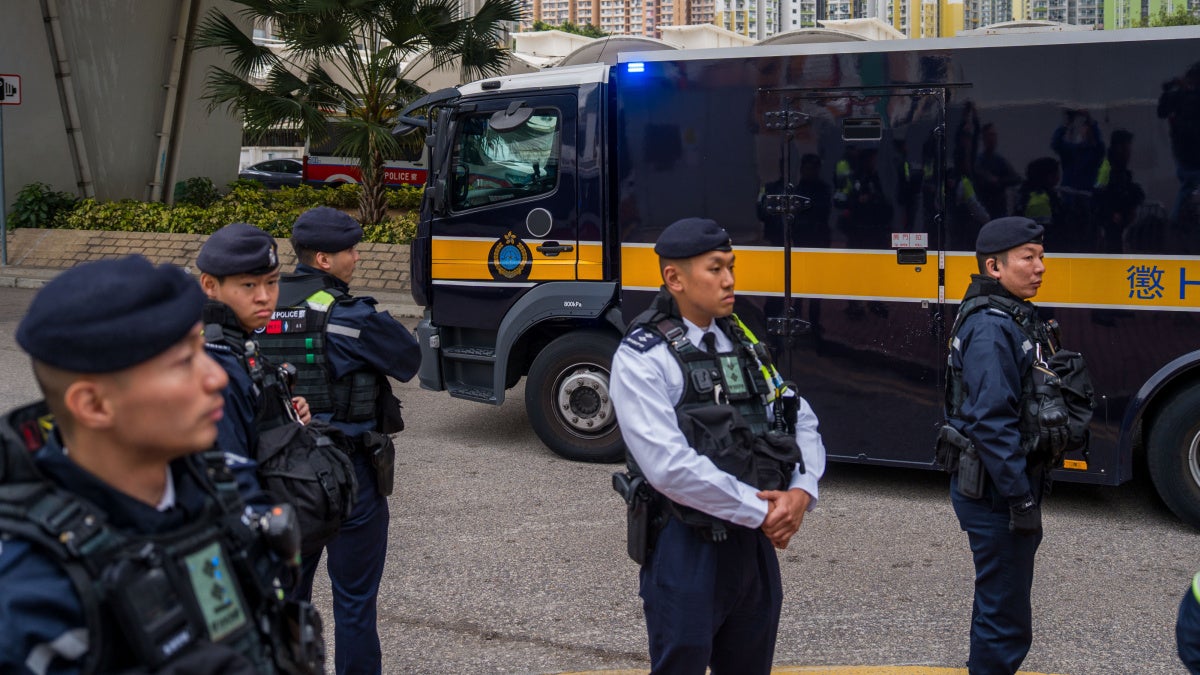
A prison van believed to be carrying Jimmy Lai leaving West Kowloon Magistrates Courts where his sentencing took place in Hong Kong, February 9, 2026.
(Tokyo) – Beijing has restructured Hong Kong’s governance to answer to Party leadership rather than Hong Kong’s people six years after imposing the draconian National Security Law, Human Rights Watch said today.
“Hong Kong’s highly repressive national security regime and bureaucracy have erased long-protected rights and cast a deeply troubling shadow over its future” said Elaine Pearson, Asia director at Human Rights Watch. “As Beijing continues to radically transform Hong Kong, the deadly Tai Po housing complex fire illustrates the tragic consequences of a society that has lost its ability to hold the powerful accountable.”
The Chinese Communist Party and state have comprehensively reengineered Hong Kong’s foundation of governance, reshaping its leadership, personnel, institutions, and ideology. The authorities no longer present national security as an exceptional response to the 2019 protests, but as a standing principle of administration. They have enforced citywide compliance by punishing increasingly minor acts and targeting ordinary people for peaceful expressions.
After Beijing imposed the National Security Law in June 2020, authorities neutralized the city’s democracy movement by imprisoning pro-democracy politicians, leaders, and activists, or forcing them into exile. They also turned the previously quasi-democratic legislature into a rubber stamp, dismantled independent media and civil society, and entrenched a national security architecture throughout the government.
The Hong Kong government has continued to expand that security architecture over the past year. In March, it granted police new powers under the National Security Law, including the authority to require suspects to provide device pa


