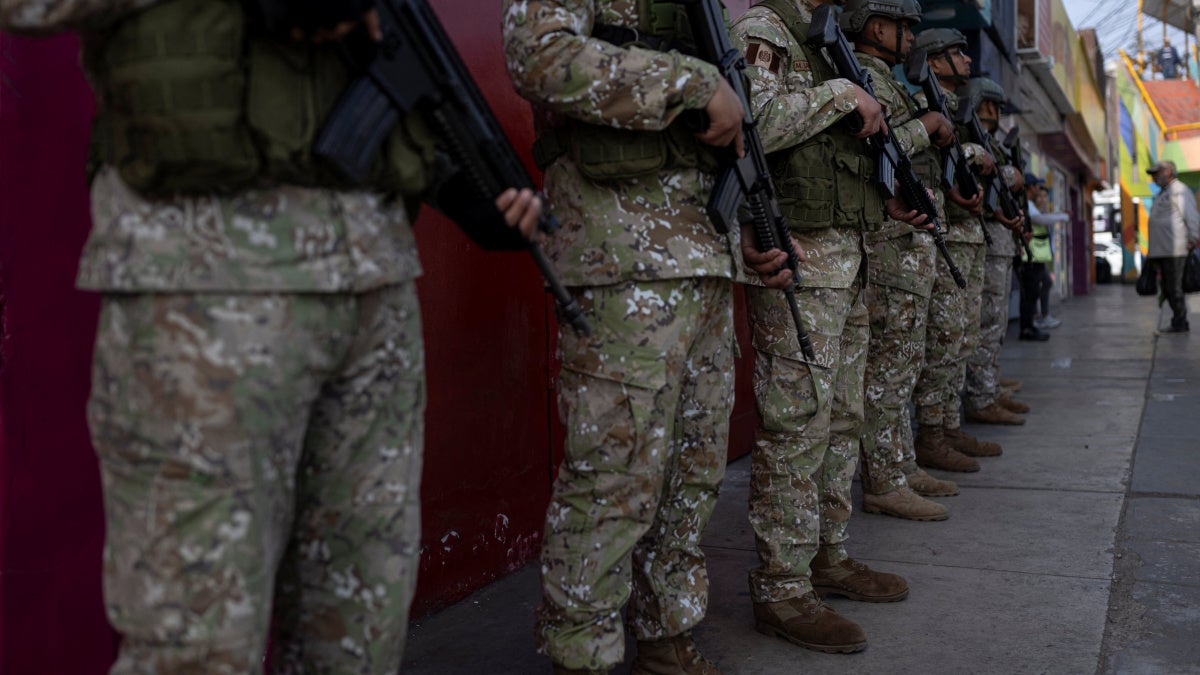
Military officers patrol a street after the government declared a state of emergency in Lima on October 22, 2025.
(Washington, DC) – Peruvian President José María Balcázar should veto a bill that would expand the military justice system, Human Rights Watch said today. The bill would effectively open the door to impunity for police officers and members of the armed forces responsible for human rights violations.
On June 23, 2026, Congress passed a bill that would modify the Military Police Criminal Code, expanding the definition of “service-related offenses,” which are handled by the military justice system. Military courts lack the independence and impartiality to adequately investigate human rights violations by security forces. Judges and prosecutors, appointed by the president, hold military rank. The changes would benefit, among others, police and military officers responsible for the killings of dozens of protesters and bystanders during demonstrations in late 2022 and early 2023.
“This bill is a recipe for impunity,” said Juanita Goebertus, Americas director at Human Rights Watch. “Signing this bill into law would give current members of the police and the military carte blanche to commit new human rights violations.”
Under the Peruvian constitution, President Balcázar has 15 days to decide what to do with the bill after Congress sends it to his office for signing. That period ends on July 17. If Balcázar lets the 15 days pass without either signing or vetoing the bill, Congress is allowed to sign it into law. If he returns the bill to Congress, the legislation would be considered by the newly elected bicameral Congress, which takes office on July 28 and would need an absolute majority to pass the law.
The bill expands the definition of “service-related offenses” to include any crime committed by the military or the police “in the context of a st