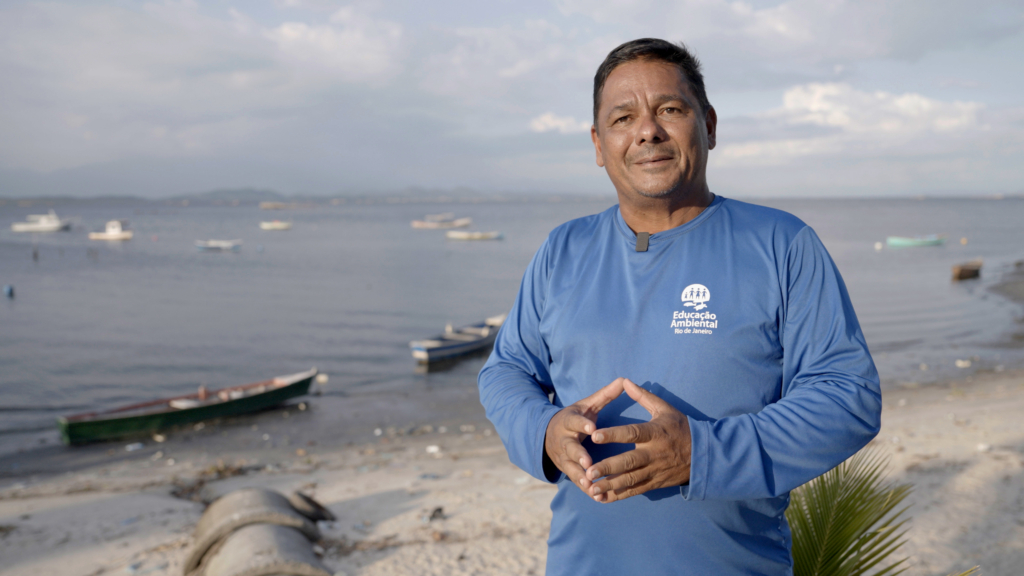
Meet
Alexandre Anderson – a water defender from Brazil
For Alexandre Anderson de Souza and other artisanal fishers, Guanabara Bay in Rio de Janeiro, Brazil, is a source of livelihood, identity and culture.
But pollution from multiple sources, including the oil and gas industry, industrial waste and untreated sewage has turned the bay into a sacrifice zone. Artisanal fishers face contaminated water, declining fish stocks, eroded mangrove, shrinking fishing areas and increasingly dangerous routes, while polluters profit without paying for the environmental degradation they cause.
Alexandre co-founded Associação Homens e Mulheres do Mar (Association of Men and Women of the Sea – AHOMAR), a network of artisanal fishers that has spent nearly two decades defending the bay and their traditional way of life from the impacts of oil and gas infrastructure.
Several environmental human rights defenders (EHRDs) told Amnesty International that they feared for their safety, some facing intimidation and harassment.
Among them, Alexandre has been repeatedly threatened and has survived several attempts on his life. Here, he shares his story
:
My name is Alexandre Anderson. I am 54 years old; I am a fisherman and I have been living and working in Guanabara Bay since 1997.
Artisanal fishing is not just a means of subsistence. It is our culture, a way of life.
In the 1990s, we felt that something was already changing in Guanabara Bay. Our elders say that when the first refinery started to work, the bay suffered a lot. There was a lot of oil around because it was next to two rivers and these rivers were used to illegally discharge sewage.
I’m not the oldest fisherman in the region, but the elders say that fish used to be abundant here, and they disappeared. It wasn’t a natural phenomenon, it was a phenomenon of man’s influence, an industrial phenomenon. Oil is not synonymous with wealth, it’s not synonymous with growth, it’s synonymous with destruction.
“No one
… [more]