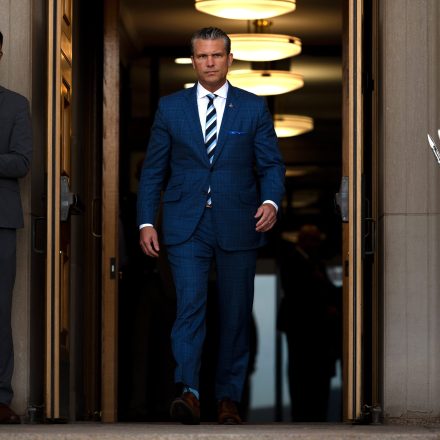
Defense Secretary Pete Hegseth
has extended a line for the military’s religious leaders to reach him directly — and current and former military chaplains say they don’t want it.
Hegseth announced the creation of a new
Office of Religious Affairs
on September 30, vowing that the office would give members of the armed forces’ chaplain corps access to him without “bureaucratic dilution.” It coincides with his
openly Christian “Send Me” campaign
, an online propaganda effort that the Pentagon launched over the summer promoting a biblical phrase widely understood as a vow to accept a
divine
mission.
“We should not be in the business of wrapping the state’s mission in one particular religion,” an active-duty Army captain serving as a non-Christian chaplain told The Intercept. But as Hegseth’s Pentagon increasingly
pushes Christianity
, the chaplain, who was granted anonymity because he feared retaliation from the Defense Department, said he and other non-Christian chaplains worry the new religious affairs office will be used to do just that.
Hegseth’s body bears an assortment of Christian and Crusader imagery, including a Jerusalem cross across his chest and the Latin phrase “Deus vult,” or “God wills it,” on his bicep — a battle cry associated with the medieval Crusades that has since been adopted by far-right extremists. His forearm bears a cross and sword referencing Matthew 10:34, in which Jesus declares that he came not to bring peace but a sword, alongside the Hebrew name for Jesus. In 2021, a fellow National Guard member flagged Hegseth
as a potential security threat
over his Deus vult tattoo, before Hegseth was removed from an assignment protecting Joe Biden’s inauguration.
Pete Hegseth’s Unholy War
As defense secretary, Hegseth has frequently turned to messaging that centers
religion
and
vengeance
while promoting the U.S. and Israel’s
unpopular war in Iran
. His “
Send Me
” campaign is built around Isaiah 6:8, a biblical v
… [more]