Just after taking
office in 2025, President Donald Trump picked a fight with Yemen’s Ansarullah, whom Americans routinely call “the Houthis.” Trump got a refresher in the limits of American military power, a lesson reinforced from Korea, Laos, and
Vietnam
to Afghanistan, Somalia, and Iraq. The U.S. military can cause a lot of damage, but it can’t win wars unless it beats up on weaklings like Grenada and Panama. After U.S. forces
killed many civilians
but failed to break the resolve of the Yemeni forces, a chastened Trump called it quits.
Trump then fought a
short war with Iran
and claimed to have “
obliterated
” their nuclear facilities before employing the full might of the U.S. military to kill scores of
unarmed civilians
in so-called drug boats and
kidnap
Nicolás Maduro, the president of the poor, weak country of Venezuela.
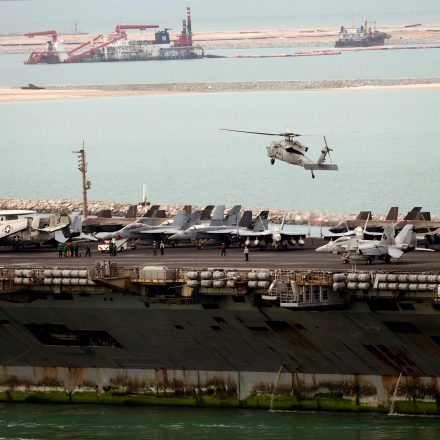
In February, Trump launched a second Iran war because the U.S. military failed. He now claims that Iran was, despite the 2025 conflict, just two weeks away from developing a nuclear missile. Trump’s second Iran war followed a predictable pattern. The U.S. was able to wipe out an elementary school and wreck hospitals and apartment buildings with no problem. But in the process, its major military bases in the Middle East — the keys to decades of American power projection in the region — were (truly) obliterated; its inability to protect itself or its allies were laid bare; and the
vulnerability of its archipelago of bases
around the world, including inside the U.S., was exposed.
After twice failing to defeat Iran, an economically strapped regional power, Trump is now mulling a third Iran war. If he goes ahead with it, the conflict is likely to ignite an even greater conflagration in the region where Ansarullah has been battering Saudi Arabia’s airports and oil infrastructure, as well as its proxies in Yemen, for weeks.
To understand the forces that fought Trump to a standstill in 2025 and those he has been unwilling to engage on b